Search "Crown Hill home prices" this week and you'll collect three answers that refuse to reconcile. One neighborhood-level tracker puts the median list price at $675,000 as of July 2026. A brokerage site quotes a median sale price of $925,000 for the same month, pulled from the 98117 zip code. A third source, tracking new construction specifically, lists a median of $800,000 as of late July.
None of these numbers is wrong. That's the part worth sitting with before you tour a single house here. Crown Hill isn't producing bad data. It's producing accurate data about two different housing markets that happen to share a mailing address, and the gap between them is the most useful thing a buyer can learn about this neighborhood before writing an offer.
Three Numbers, Three Different Slices of the Same Neighborhood
Here's what each figure is actually measuring, side by side:
| What's being measured | Geographic scope | Figure | As of |
|---|---|---|---|
| All active listings, list price | Crown Hill neighborhood boundary | $675,000 median | July 2026 |
| All closed sales | Zip code 98117 (stretches into Ballard) | $925,000 median | July 2026 |
| New-construction listings only | Crown Hill neighborhood boundary | $800,000 median | July 22, 2026 |
Zip code 98117 is the same one that covers a wide swath of Ballard, so a "Crown Hill" number pulled at the zip level is quietly folding in Ballard's higher price floor. Meanwhile, a number pulled at the tighter neighborhood-boundary level is measuring something narrower, and it moves depending on whether that snapshot happens to catch a run of older single-family listings or a cluster of new townhomes.
That's the first mechanism behind the spread: nobody agrees on where Crown Hill ends and Ballard begins, and the boundary you use changes the answer by six figures.
The Zoning Line That Explains the Second Mechanism
The boundary problem alone wouldn't produce this much noise. The bigger driver is what's actually zoned to be built here, block by block.
Crown Hill sits inside its own Urban Village, a designation the city uses to concentrate growth near transit. But the zoning inside that village is unusual. A narrow strip of mixed-use midrise zoning runs along 15th Avenue Northwest, and it's boxed in on both sides by low-rise zoning and Residential Small Lot, or RSL, zoning, which is essentially single-family zoning with smaller minimum lot sizes. The Urbanist has described Crown Hill's zoning as among the thinnest of any Seattle urban village relative to the transit service running through it.
RSL zoning matters here because it changes the math on a legacy lot. Instead of one single-family home on one standard-sized parcel, RSL allows that same parcel to be split into two smaller lots, each holding its own home. Sightline Institute has tracked how this kind of small-lot rezoning plays out inside Seattle's urban villages, and Crown Hill was one of the neighborhoods most affected by it. In fact, when the city studied where to expand these zoning changes as part of its Mandatory Housing Affordability program, the Seattle Times reported that Crown Hill faced the greatest encroachment into single-family areas of any urban village in the city, with changes pushing into blocks on both sides of 15th Avenue Northwest.
That history is why you can stand on one block in Crown Hill and find one of the neighborhood's original single-family homes on its full 5,000-square-foot lot, then walk half a block and find two brand-new townhomes sitting where one house used to be. Both are legitimately "Crown Hill." Only one of them is pulling the median down.
What's Actually Going Up Right Now
This isn't theoretical. Two projects show the mechanism in motion.
At the corner of 15th Avenue Northwest and Northwest 85th Street, in the heart of the neighborhood's midrise strip, an aging retail row that included a corner bar called Goofy's and the longtime Crown Hill Pub came down to clear the site for a seven-story, 194-unit apartment building. Construction broke ground on the project in 2023, built by Quarterra Multifamily on land originally entitled by Graham Capital, and it sits exactly where the zoning map said density would land: the commercial corridor, not the residential blocks around it.
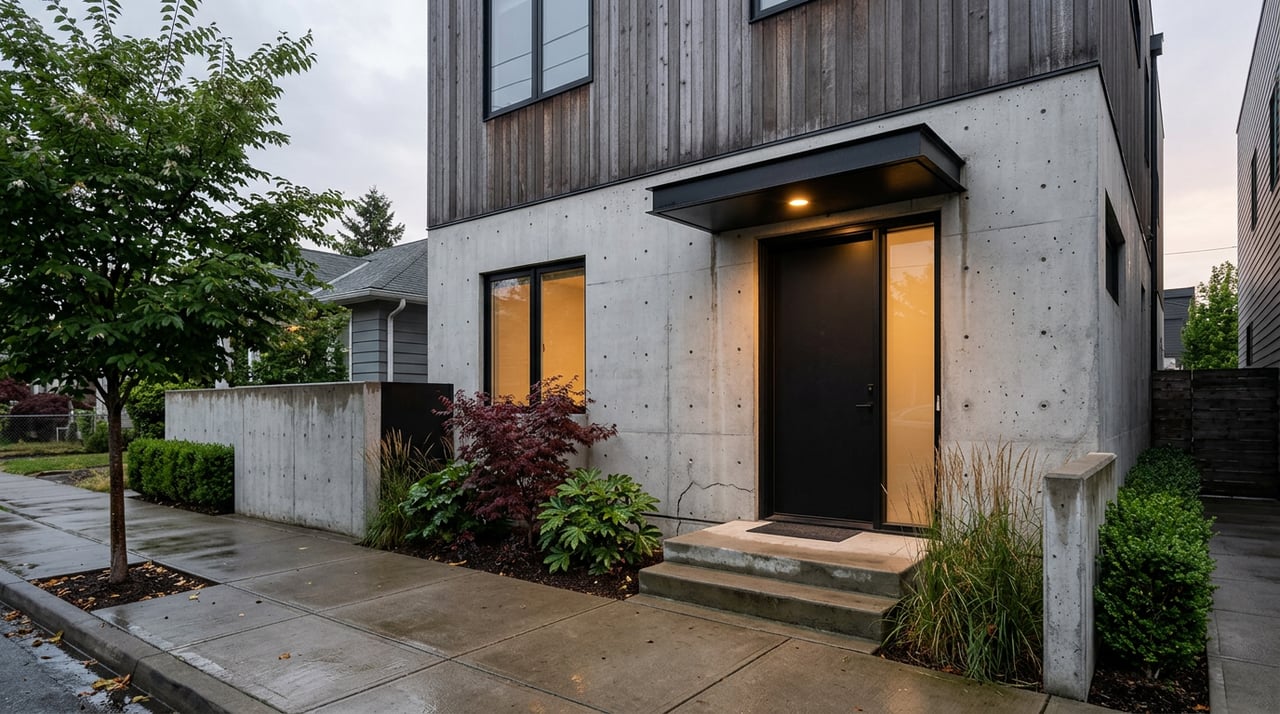
A few streets over, a new townhome community called Ivy North went up directly across from Crown Hill Park, with builders including Shelter Homes delivering multiple standalone and attached units on lots that once held a single home apiece. These aren't outliers. They're the RSL mechanism, built.
Neither of these projects erases the older housing stock around them. Crown Hill still has a real base of postwar single-family homes, the kind that start well above $800,000 and run past $1 million for anything updated or view-oriented. What's changed is that those homes now sit inside a market that also includes a fast-growing supply of smaller, newer, less expensive product on the same streets. Averaging the two together is where the confusing numbers come from.
What This Means If You're Cross-Shopping Crown Hill Against Ballard
For a buyer comparing Crown Hill to Ballard proper, the practical takeaway isn't which median to trust. It's that "median" is close to meaningless here without a follow-up question: median of what?
If you're looking at a legacy single-family home, the relevant comps are other legacy single-family homes on similarly sized lots, not the new townhome that closed two doors down for $200,000 less on a fraction of the land. If you're looking at new construction, the reverse is true. An appraiser who mixes the two pools without adjusting for lot size and construction age can produce a value that surprises everyone at the table, which is exactly the kind of friction that shows up during financing rather than during the tour.
A few questions worth asking before you write an offer on a Crown Hill property:
- Is this parcel zoned RSL, low-rise, or single-family, and does that classification match what's actually built on it?
- Are the comparable sales your agent or lender is pulling drawn from inside the Crown Hill neighborhood boundary, or from the wider 98117 zip code?
- If the home sits within a block or two of 15th Avenue Northwest, has a lot split already happened next door, or is one pending?
None of these are exotic questions. They're the difference between a clean appraisal and a renegotiation.
Frequently Asked Questions
Is Crown Hill technically part of Ballard? No. Crown Hill is its own recognized Seattle neighborhood, bordered by Ballard to the south, Greenwood to the east, Blue Ridge to the north, and Olympic Manor to the west. It shares zip code 98117 with Ballard, which is one reason zip-level price data blends the two together even though the neighborhood boundaries are distinct.
What does RSL zoning actually change for a buyer? Residential Small Lot zoning allows a standard single-family parcel to be split into two smaller lots, each eligible for its own home, with the same 30-foot height limit as surrounding single-family zoning. It's the reason new-construction townhomes have been appearing on streets that were, until recently, entirely made up of larger, older single-family lots.
Will the new apartment building at 15th and 85th affect home values nearby? It's too soon to draw a firm conclusion, and any specific price effect should be evaluated with current comps rather than speculation. What's clear from the zoning map is that the building landed exactly where the city's midrise corridor is designated, which is consistent with how Crown Hill's Urban Village was planned to absorb density along its transit-served spine.
If you're weighing Crown Hill against Ballard, or trying to figure out whether a specific listing is priced against the right set of comps, that's a conversation worth having before you're three weeks into an appraisal contingency. Joyce Juntunen works this stretch of northwest Seattle block by block, not just zip code by zip code, and can walk you through which numbers actually apply to the home you're looking at. Let's Connect.